

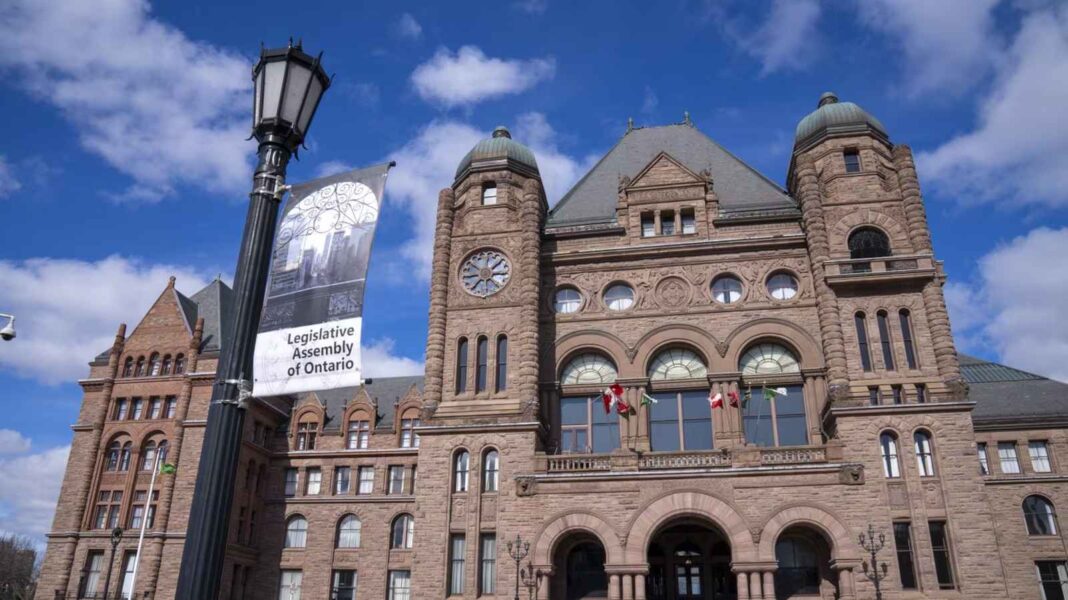

Nearly half of all of Ontario’s 60,000 public service workers are set to return to the office full time next week after years of hybrid work arrangements.
They’ll join tens of thousands of other employees from banks, tech companies, and the telecom sector who have also been called back to the office in recent months, as part of a trend that is shifting away from remote work.
Statistics Canada data shows that for the fourth year in a row, the proportion of employed people mostly working from home is falling and as of May of last year, 76 per cent of all workers in Toronto were commuting.
It’s the end of an era for Ontario Public Service (OPS) workers, who had enjoyed more flexible work arrangements since the onset of the COVID-19 pandemic. Those who were able to had been working remotely for part, or all, of the first two years of the pandemic, before they were called back to the office a minimum of three days a week in 2022.
Then, in August, the province announced that those who were not currently in office full time (roughly half), would need to come in four days a week starting in October and five days a week starting Jan. 5.
In making the announcement, the government said its return to office policy was in line with the current workforce landscape and Premier Doug Ford claimed workers are “more productive” in person.
“How do you mentor someone over a phone? You can’t. You’ve got to look at them eye-to-eye,” he said at the time.
So, what could the return of thousands of workers mean for Toronto? We asked the experts to find out.
A ‘local economic depression’: economist
According to the Strategic Regional Research Alliance, office occupancy in Toronto has been improving in recent years but still lags behind what it was before COVID.
The most recent data shows that, as of Nov. 15, the average weekly office occupancy in the city is 82 per cent, down from 92 per cent pre-COVID.
“I think that the key thing to note is just that, because these workers have not been in the area, it’s led to basically a local economic depression,” said Colin Mang, an economist at McMaster University.
After the province announced it was calling workers back, Ford pointed out that he’s seen firsthand the indirect negative effects of remote and hybrid work arrangements, specifically in the downtown core.
“I’ll just use downtown Toronto, for example, the PATH. You know there’s hardworking entrepreneurs that basically their businesses just died when they weren’t seeing the flow of traffic,” he said at the time.
In July, data from Environics (commissioned by The Globe and Mail) showed that downtown foot traffic in Toronto was still 46 per cent lower in May 2025, compared to January 2020.
The same data showed that foot traffic was even lower in Ottawa (77 per cent of pre-COVID levels). Some have linked the struggles experienced by businesses in the nation’s capital to a lack of federal office workers, most of whom are currently working from home two days a week.
“Having people come and commute to your downtown core, it generates a lot of economic activity, and that’s really been missing the past couple of years with back-to-work mandates, both in the private sector and in the public sector,” Mang explained, noting that the Toronto’s downtown, specifically the PATH, has lost some of the “vibrancy” it had pre-COVID.
“You notice it. It’s just not what it was before the pandemic. So, bringing these workers back, part of that is around generating more economic activity in the downtown core, because that’s really suffered over the last five years.
It’s worth noting that not all of the province’s 60,000 OPS workers are in downtown Toronto but the province said the majority are located in the Greater Toronto Area.
Will Toronto traffic get worse when workers come back?
It’s no secret that Toronto has a traffic problem. In fact, it was once ranked the worst city in North America for congestion by navigation company TomTom.
Some had feared that the return of more BMO, RBC, TD, Scotiabank, and Rogers Communications Inc. employees (to name a few) in the fall would have led to an even more dire situation on the roads.

But according to Karen Chapple, director of the School of Cities at the University of Toronto, the impact didn’t materialize then—and likely won’t materialize on Jan. 5 either —due to a lack of office space.
Like the OPS, Chapple says that U of T will begin requiring its employees to come into the office full time starting in January, and it’s already clear they don’t have enough room.
“We have the same issue which many of the folks had in September, and which the province may have as well, which is we don’t have enough desks,” she said, referring to reports that some of the aforementioned banks ran out of physical space to host its employees in October.
“We can’t have people sitting on each other’s laps…Some people shrunk their space. Other people hired more people. So, you’re not actually going to see people there five days a week,” she said.
Ford was asked about that issue in December, specifically about the ongoing renovations at Mackenzie Block which will house thousands of public servants when the project is finished.
“Yeah, we’ll have enough office space. We’ll make sure everyone gets in there,” he said.
Chapple went on to say that she expects there will also have to be some flexibility around the return to the office for workers. She said employers have become more understanding about work-life balance since COVID-19 and that considerations will need to be made for those caring for the elderly, children, or those with illnesses, or resignations may follow.
“It’s not like it was in 2019. There’s a new kind of tolerance,” she said. “The rules will need to be relaxed for these practical reasons, and because of the need to keep people happy and have a qualified workforce and not lose a bunch of people overnight.”
At time of writing, more than 10,000 public servants have reportedly said they want to work from home at least one day a week, according to the Ontario Public Service Employees Union. When Ford was asked about that development, he said: “You have to come back to work. Simple as that.”
Big picture, Chapple said she anticipates there will be a “little bit of a bump” in traffic to start the New Year as employees head back, but not “much more than normal.”
“And we always have more traffic in the winter because fewer people want to take the transit anyway, so we probably see that kind of normal, slight bump up and congestion, which will relax a little bit as the weather gets better.”
CP24